RBA cuts rates 0.25 per cent to 3.6 per cent as inflation sits within target band and unemployment rises to 4.3 per cent. Housing market momentum to strengthen with $750k mortgage saving $155 monthly.
The Reserve Bank of Australia has delivered a 0.25 per cent cut to the cash rate today, reducing it to 3.6 per cent as quarterly inflation data confirms that price pressures are contained within the target band. With headline inflation at 2.1 per cent and trimmed mean at 2.7 per cent, combined with unemployment rising to 4.3 per cent in June, the RBA has provided measured stimulus while maintaining flexibility for future policy adjustments.
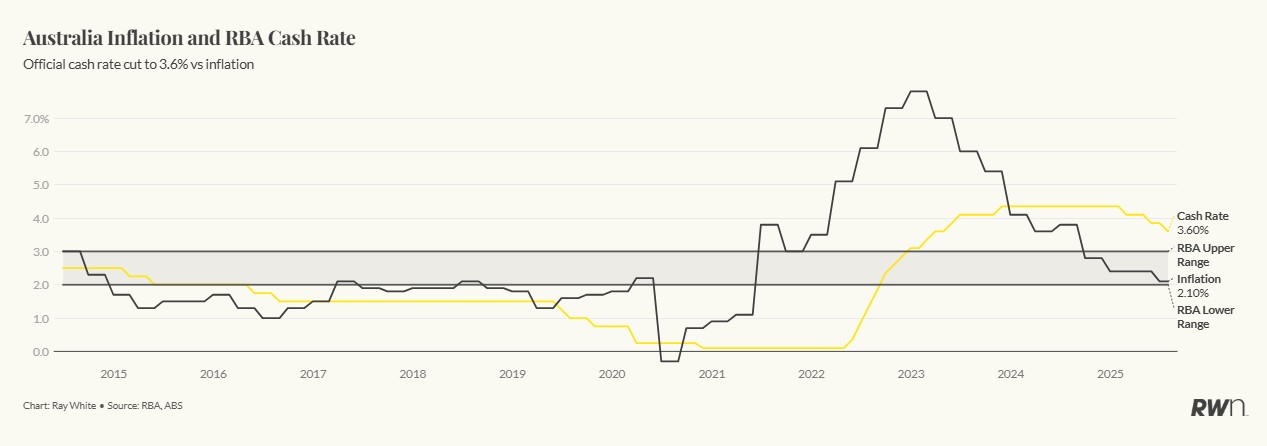
Today’s cut reverses July’s surprise hold, when the RBA expressed caution about monthly inflation readings potentially understating broader price pressures. However, last week’s comprehensive quarterly data validated the monthly figures, confirming that inflation is genuinely within the target range and providing the central bank with confidence to ease policy.
Measured response to labour market softening
The decision to cut by 0.25 per cent reflects the RBA’s balanced approach to emerging economic uncertainty. While unemployment has risen from 4.1 per cent to 4.3 per cent, the increase remains relatively modest, suggesting the RBA sees scope for gradual rather than aggressive policy adjustment.
With markets having fully priced in today’s cut and expectations for the cash rate to reach 3.0 per cent by year’s end, the RBA’s conventional approach suggests additional cuts are likely before December. The measured pace allows policymakers to assess the impact of each adjustment while maintaining ammunition for more aggressive action if labour market conditions deteriorate further.
Trade uncertainty managed cautiously
While US tariff policies continue to create global uncertainty, the RBA appears confident that domestic inflation remains manageable. The more pressing concern for Australia continues to be China’s economic slowdown, which is affecting commodity demand and employment in export-dependent parts of the economy.
Today’s cut suggests the RBA views current inflation outcomes as providing sufficient buffer against potential price pressures from trade disruptions. However, the measured approach also reflects ongoing uncertainty about how quickly external factors might affect domestic price dynamics.
Housing momentum to strengthen
Today’s cut will inject additional stimulus into an already accelerating housing market. For a household with a $750,000 mortgage, this reduction represents monthly savings of approximately $155, providing increased borrowing capacity that will support housing demand.
With major markets already showing strong momentum, particularly Perth’s 1.3 per cent monthly growth, this rate cut will amplify existing trends. Melbourne and Sydney are likely to see accelerated growth as rate-sensitive buyers respond to improved affordability, building on their current monthly growth rates of 0.5 per cent.
The national house price median of $941,000 and unit median of $695,000 are positioned for continued acceleration. If current growth rates are sustained with this additional stimulus, annual house price growth could reach 10 to 12 per cent, potentially pushing the national median towards $1.05 million within 12 months while maintaining more manageable appreciation rates than under aggressive policy easing.
